Welcome!

my daily life on a cattle farm, my love of agriculture, and stories behind my photos

Showing posts with label cattleman. Show all posts

Friday, November 8, 2019

inline wrapping hay


Three years ago, we wrapped round bales of hay for the first time. The weather would not allow us to bale hay before forecasted rain. So, we decided to set our baler in order to bale high moisture hay. The bales were then wrapped to ensile. Wrapping the bales allowed us to bale hay despite unfavorable weather conditions.

 
Over the past three years, we have continued to wrap hay. This has given us so much flexibility in baling. And, it stores our high quality hay outside for the winter. Wrapping bales shelters the hay from weather... rain, snow, and ice. So, it preserves the quality and nutritional value of our hay. 

Friday, May 4, 2018

Friday on the Farm


5.4.18
On April 13, we no-till drilled a field. We seeded the field with oats, brome, alfalfa, alsike clover, and red clover. A rate of 2 bushel of oats, 2 pounds of brome, 10 pounds of alfalfa, 1.5 pounds of alsike clover, and 3.5 pounds of red clover was used per acre. This field will be future hay ground as forage for cows. 
 
[  agriculture photos @ monicastevens.photoshelter.com  ]

Saturday, November 4, 2017

the farm office

the farm office is the heart of the cattle farm...
  

On our Shorthorn cattle farm, it is very important to have a nice office that is purposeful and well organized. I love to be and need to be organized. Since I often work long hours at times throughout the year in my farm office, I also want a space I love. If I have an office I adore and enjoy working in, I will be much more productive. And, I do love working in my office! I think it's pretty cute...  
 
functional  +  funky
 
black saddle chair
black painted captain chair
laptop & wireless printer
iPad
telephone
desk calendar
sea grass basket [ calendar, patterned binder, portfolios, and Vigortone manual ]
b&w print magazine holder [ natural paper file folders labeled with a black Sharpie ]
clear lamp with burlap shade
2 barn board shelves
clock
sea grass basket [ black binders and a clipboard for cattle records ]
clear + turquoise tote [ calving records ]
black tray [ additional cattle records ]
purple sticky notes
patterned notepads
mini clipboard + notepad
binder clips in an antique Atlas jar
Sharpies [ in my favorite colors...lilac, purple, turquoise, magenta, orange & lime ]

In three desk drawers...
drawer #1    paperclips, business cards, notepads, rubber stamps, and ink

drawer #2    3 hole punch, pens, scissors, washi tape, and string

drawer #3    printer paper, printer ink, file folders, and legal pads


Rustic...the style I have always loved. My favorite colors to use in decorating are black and brown. Then, I add pops of color throughout... purple, yellow, or turquoise. The wall of my office is painted black. And, I absolutely LOVE it! It coordinates well with the two barn board shelves above the desk! The black wall creates a warm and cozy space for my farm office.


A clear lamp with a burlap shade sits on my desk. It adds a warm light as I work. A desk calendar with ultra-fine Sharpies keep track of everything important on the farm. A sea grass basket and b&w print magazine holder are in close reach of working at my desk... while being organized and cute. The wall clock hangs just above the desk. It can easily be seen to help keep me on task.

Onto the backs of black buttons, I glued tacks. The tacks were then pressed into the baskets. So simple and cute! They add an adorable touch to the sea grass baskets. One of these sea grass baskets holds black binders of cattle records. This basket allows quick access to records off a barn board shelf while looking rustic chic.
 
 
I had two extra wood chairs and decided to paint them black. They were sanded for a rustic look. It is perfect for an extra seating at the side of my desk!

 
To add a little of my style to my office
. soy candle
. wax warmer [ linen scented ]
. edition of Feeds and Feeding textbook
. turquoise antique Ball jars - Grandma Stevens
. antique feed scale - Grandpa Stevens
. primitive sheep figurine
. farm photos
. rope knot [ purchased @ Bishop Hill ]
 
feeds and feeding - one of my favorites
 
rope knot from bishop hill
Hanging above my desk is this cute rope knot from Bishop Hill! I love it in my office!


My favorite farm photo is a b&w print of my dad as a little boy bottle feeding his lamb. It is so cute! I will always cherish it. The framed photo goes well with the antique scale of my grandpa Stevens.
capture life
capture life...perfect for this agriculture photographer! I found this adorable wood sign at Barn Owl Primitives! It is on a barn board shelf beside a antique turquoise Ball jar.

my favorite mug from magnolia market
 I adore this mug! It was a from my visit to Magnolia Market in Waco, TX! 

Sunday, August 27, 2017

renovated calving area


We renovated an area of a barn for calving. We were in need of extra room during the calving season...especially with cold and wet weather. This renovated area of the barn gives us a permanent space for calving assistance, as well as flexibility for additional space during calving. In the fall of 2015, concrete was poured as a floor for the For-Most calving tub and cow/calf pens.


wood chip base spread for the pens

Two 10 x 12 pens were set up in the back of the barn to use for cows and their newborn calves, or for monitoring a cow close to calving. And if we delivered a calf in the calving tub, we can easily move the pair into a pen next to it. We use wood chips as base  in the pens to keep calves clean and dry. The wood chips work very well for calving. With using them, we can keep the pens clean throughout the day. We use straw in the corners of the pens as warm bedding for calves.

In the renovated calving area, I am able to store our OB equipment near the For-Most calving tub. This is perfect for quick access when we are in need of assisting a cow in calving. There is also plenty of space to store square bales of hay, feed, extra gates, a pitch fork and broom, extra wood chips, straw for bedding, and even my 4-wheeler.


I decided to paint the back wall of the pens. My dad wondered why I would since the cows would paint it themselves. So, I painted a shade of brown to camouflage the cow manure.


Two sheets of steel were removed from the roof and clear panels were installed for additional lighting in the calving area. They worked amazingly! These clear panels let in so much natural light...especially so in the pens at the back of the barn. They also bring in some warmth from the sun.


New wiring and lights will be completed in this area of the barn for improved lighting to work at night. And, my plan is to install barn cameras in the near future.

Friday, August 11, 2017

2017 calving data

It is calculated. Our calving data for 2017...


In our purebred Shorthorn cattle herd, detailed records are extremely important to us in our management. During calving season, we track information through our unique record keeping we have developed over the years.
 
We had a 98.5% calving rate for 2017. Of our calves, 56% were bulls and 44% were heifers.

We calculate calving ease to determine the percentage of calves born unassisted (on their own without our help). This calving season, 79.1% of calves were born without assistance and 20.9% of calves were assisted in birth. We monitor our cows very closely and assist cows or heifers in calving when needed. This is especially so with heifers calving for the first time. We want them to concentrate on their newborn calf. So, the percentage of assisted births are normally higher for us because we want to increase our odds of success. As cows and heifers are in process of calving, we watch for progress. If a half hour has passed after the water bag has broken and there has not been much progress, we assist the cow or heifer in calving. We do not want her or her calf to be stressed. A lack of progress may indicate a possible issue...multiple births, or malposition (breech, backwards, upside down).     

Calves are vaccinated, tagged, and weighed at birth. The average weight of calves born at farm G (2 - 4 year old cows) was 82 pounds. And, the average weight of calves born at farm M (5 - 10 year old cows) was 96 pounds. 

During the calving season, we feed hay to our cows in the afternoon. We feed our expecting cows around 4:00 pm to increase the odds of calving during the day. If cows have calving issues, we will already be awake. We have used this feeding method for more than 30 years. And, it has proven to work well for us. In 2017, 91% of calves were born during the day and 9% of calves were born at night.    

Along with this data, individual records are kept for each calf born on our farms. We are able to track each calf throughout its life. The 2017 calving data is printed on colored paper and stored in a binder for reference. And, we often refer to it.


Thursday, February 2, 2017

calf kit

Calving season is approaching! So, I have been organizing and preparing. To help keep me focused, I made a 2017 calving task list. I crossed off another task on the list by putting together our calf kit. Check!
 
 
The calf kit carries... a roll of paper towels, Clorox wipes, pliers, flashlight, calf halter (if needed) temporary paper tags, glue, marker, calf weight tape, calving book, calendar, pregnancy records, Super 7+ iodine, and shots included in our health program. When a calf is born, we will take this kit with us.    
   
calf kit
 
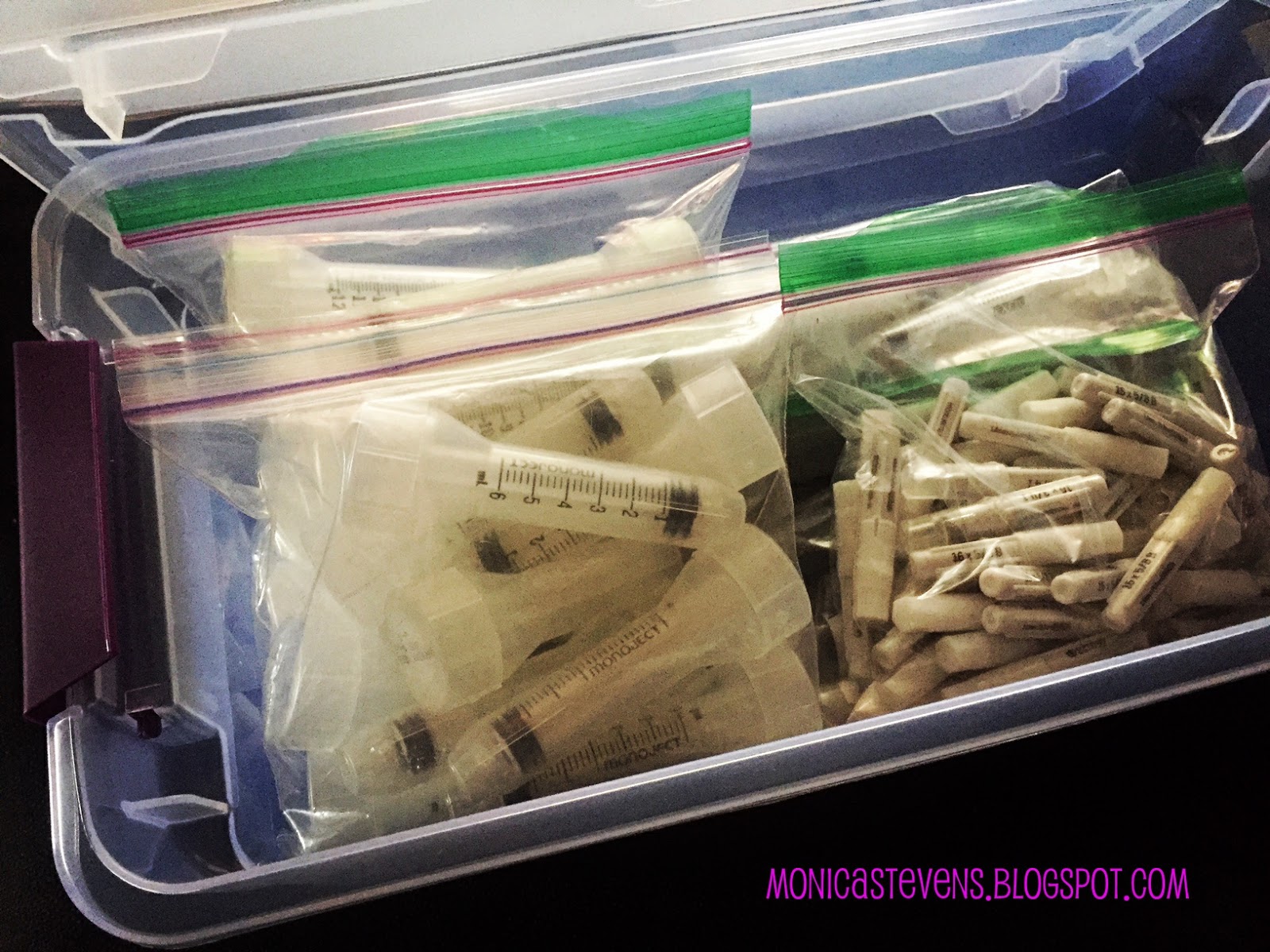
In a clear plastic box, I organized and stored extra needles and syringes of different sizes. This box is perfect to keep new needles and syringes clean and ready to use for the calving season.
 
needles & syringes
 

tagging box


Our calf tagging box is prepped to tag the 2017 calves!
 
The tagging box holds supplies for tagging our bull and heifer calves. It keeps our tags and buttons, tagger, pencil, and tag markers all together.
 
Bull calves will get an orange numbered tag. And, heifers will get a yellow numbered tag. With a tag marker, the numbered tag of the cow and bull are written on each calf tag. As calves are born, a list is kept to make tagging easier.    
 
2017 calves
 

ob calving kit


We are just under five weeks away from calving! So, I have been busy in preparation!
 
Our OB calving kit includes a bucket for soap and warm water to sanitize, a halter (if needed), 60" OB chains, two handles for the chains, and a bottle of lubrication. We also have two calf pullers on hand...one for each farm. The supplies were cleaned and sanitized to be ready in case we need to assist a cow in calving.

Saturday, January 28, 2017

silage analysis

We are feeding corn silage to our feeder calves, and herd of 2 - 5 year old cows. On Wednesday afternoon, I sent off a sample of silage for feed analysis.
 
silage sample ready to send

I pulled a sample of silage out of the bag and filled a quart sized bag to send to the laboratory. The sample was sent to Dairyland Laboratories via UPS. For a basic test, it was $16. 

silage sample report

The sample was shipped to be received on Friday. And shortly after being received, I was emailed results.
 
 
For future use of Dairyland Laboratories...forms, sample bags, and mailers were sent to me.

Friday, October 21, 2016

weaning vaccination program

weaning health program
We are weaning calves on Saturday. So, we have been very busy preparing this week...barn and lot cleaned, barn bedded with wood chips, hay in the lot, scales ready to weigh calves, corn and oats available, protein ordered, and vaccines picked up from our veterinarian. 
 
I spoke with our veterinarian earlier this week about our health program for calves at weaning. We discussed in length about our weaning health program. After chatting with Dr Baird, I ordered product to vaccinate our calves. Over the past 30 years, we have developed a great herd health program with our veterinarian. Throughout the year, we vaccinate our cows and calves to prevent disease and sickness.
 
Our calves will receive four shots when we run them through the cattle chute:
2cc BoviShield Gold
2cc 20/20 Vision 7
4cc Vitamin ADE
8cc Penicillin
 
Our weaning health program costs $7 per calf. This program will ensure us that our calves will remain healthy.    

Tuesday, June 7, 2016

The boys of summer

The boys of summer...

hello, ladies!

Four bulls were hauled to the pastures on May 28 for the breeding season. Before turning the bulls out with the cow herds for the summer, we ran them through the chute for their routine health program. Each bull received a Breeding Soundness Exam [BSE] by our veterinarian and technician, as well as vaccinations as part of our herd health program developed with our veterinarian.
 
A Breeding Soundness Exam includes: a physical examination of the bull, Scrotal Circumference [SC] measurement, and a semen sample for testing. It is crucial that each bull be able to successfully breed cows. The physical examination of the bulls includes their Body Condition Score [BCS], scrotum, eyes, legs, and feet. The bulls were evaluated for Scrotal Circumference and measured 38-45 cm. Excellent! Each bull exceeded the recommended measurement. The Scrotal Circumference measurement is important because correlates to the production of semen. A sample of semen is collected to examine underneath the microscope while on the farm. The semen sample is evaluated for sperm motility and concentration. All our bulls were classified by Dr Baird as satisfactory breeders. The bulls received a series of shots as part of our health program developed with our veterinarian... Vision 7 for pink eye, LongRange for internal and external parasites, and fly tags.  

Saturday, January 30, 2016

calving vaccinations

The countdown to calving begins! We are about 5 weeks away from the start of calving. And, I have been busy preparing. I've put together our calving kit...Clorox wipes, paper towels, flashlight, calving record book, weight tape measure, iodine, syringes, needles, vaccinations, paper tags, marker, and glue. 
 
 
When our calves are born, they receive a series of shots...Vitamin B12, Bo-Se (Selenium and Vitamin E), Enforce 3 - Bovine Rhinotracheitis Parainfluenza Respiratory, CalfGuard - Bovine Rota Coronavirus, Clostridium with E Coli, and penicillin. Our health program for calving costs about $35 per calf. But, it gives our calves a great start to a healthy life!

Sunday, January 24, 2016

calving records prepared for 2016

Calving is soon arriving!


calving records

We start calving the first week of March. So, I have started organizing. This week, I have taken time to prepare records for calving season. One very important part of our purebred Shorthorn herd is records. And with calving season, it is extremely important to have detailed records. Over the 70+ years of raising purebred cattle, we have developed a thorough record keeping system. Through our records, we are able to track each calf throughout its life.
 
Our record keeping system for calving includes:
. one copy of our herd pregnancy records as a due date reference kept in the calving binder
 
. spiraled notecard calving book that we use to track the birth details of each calf . we include; cow number, date and time of birth, sex of calf, coloring, type of birth, weight of calf, calf identification, and sire . the calving book is kept in the calf vaccination kit and is written in when we weigh and vaccinate a calf at birth
 
. record sheet for each calf that is printed and kept in the calving binder . this sheet is similar to the calving book . it includes: cow number, tattoo, color, due date, sire, farm, date and time calved, paper tag, sex, weight, color, type of birth, numbered tag, vaccinations, date vaccinated, other comments (issues nursing, cow temperament, presentation of birth), and any other treatments given. the record sheet is saved as an Excel document and printed . a different colored paper is used for the calf record sheet each calving season
 
. handwritten list of calves born located on a clipboard and includes a pen . the list includes : cow, date of birth, farm, sex of calf, calf weight, color, sire, paper tag, and numbered tag . this list is extremely useful for tagging calves with their numbered tag, and tracking total number of heifer and bull calves

. spreadsheet list of calves kept in the calving binder . this is the same as the handwritten list but is saved as an Excel document to be viewed on the laptop or tablet  

 
. container that holds paper tags with glue, and a Sharpie are kept in the vaccination kit . the temporary tag for calves will match the numbered tag of the cow

Wednesday, December 30, 2015

Bedding...wood chips

loads of wood chips delivered to the farm
 
A couple years ago, we accepted a few loads of wood chips after a tree service trimmed trees nearby for our power company. We found the wood chips made great bedding for the feeder calves. It kept them very dry and comfortable through the fall and winter. Since then, we have loads of wood chips delivered each year to use as bedding for the calves. 

The wood chips are piled and stored outside. And, we use from that pile as needed. When we need to bed down the barn with woodchips, the loader tractor with the bucket attachment scoops them up and dumps them in the barn to be spread out on the floor. It works out pretty well. For calving season this spring, dad had me load the manure spreader with wood chips. I backed into the calving barn and spread the woodchips onto the floor of the barn. That was pretty amazing!

Yesterday, eight loads were hauled to the farm for the feed lot. We are very happy to be able to use the wood chips!

Friday, May 15, 2015

Pelvic Area Measurements

We moved replacement heifers to pasture to graze for the season on April 15. Before doing so, we ran the heifers through the chute for tattoos, and a dose of MultiMin and LongRange.

Many factors are considered in selecting replacement heifers. This year, we decided to measure the pelvic area of our heifers. The measurements provided us with data we utilized to help select heifers. Dr Baird used the Krautman-Litton bovine pelvic in measuring the pelvic area. 


All measurements were recorded to We were very pleased with the measurements of our heifers! All heifers were suitable for calving...measuring well over 200 cm2. An larger pelvic area helps increase our chances in unassisted births.
 

Sunday, March 1, 2015

Cattle records prepared for 2015


laptop and tablet sit at my desk in my farm office

Last fall, I purchased a Dell  laptop and tablet.  On my laptop, I recreated all of my spreadsheets used to keep records on our Shorthorn cattle herds...bulls, calving, calves, health program, replacement heifers, weaning weights, and pregnancy checking. All records are printed and kept in binders, as well. Our cattle records are always easily assessable.
 
 
Through One Drive, I am able to view all cattle records on both my laptop and tablet. If I have my tablet in the barn or out to the pasture, I can update or view cattle records at that moment. Pretty amazing!
 
This is my first tablet, so I am pretty excited to use it on the farm. This year, my plan is to purchase barn cameras to be used for calving season. I will be able to view the barn cameras anywhere from my laptop or tablet. So exciting! 
 

Friday, February 27, 2015

Friday on The Farm

red #8
Red #8 is a replacement heifer of mine due to calve in March. She has such a beautiful udder! A cow chick can appreciate a beautiful udder :)
 
Walking through the cow herd on a farm one afternoon, my dad and I noticed how her udder was forming. We sorted her into the calving barn to start watching. This morning at 2:00 am, I drove to the farm to check her and three other heifers close to calving. This afternoon, we hauled her to my house, so I can better watch her.

Calf watch... 2015

Calf watch 2015 has begun! This morning at 2:00 am, I drove to a farm to check replacement heifers to close calving. We closely watch our cows during calving season, but especially the replacement heifers incase they are in need of assistance in calving. It is a frigid calving season so far. At 7:00 am this morning, it was -12. We manage our cattle even more intensely due to the weather.
 
Cows and heifers due to calve early to mid March have been sorted and moved to the calving barn to watch throughout the day and night. Barns have been bedded down with straw or cornstalks to keep cattle warm through the cold weather.
 
Walking through the barns at night, is so peaceful. Oh, the grunts of expecting cows.

Saturday, February 14, 2015

i heart agriculture

i HeArT agriculture

. farm . family . faith . love . tradition .

Every morning, I am blessed to wake up and do what I absolutely love...raising cattle. In my heart, I truly believe it was something I was born to do. Raising cattle is a family tradition. And, I am extremely proud to be a third generation cattleman. Raising cattle is about family, faith, love, and tradition. We take great pride in being stewards of our land, and caretakers of our cattle. It is tough work...blood, sweat, and tears. Though, it is extremely rewarding. I am able to see our work and dedication in our healthy cattle herds.

Friday, January 9, 2015

My wishes for the cattle farm...

I have quite a few wishes for the farm this year. I will need to work hard to make my wishes come true. But, it will be well worth it. I want to constantly improve.
 
. purchase barn cameras for the calving season
. build cattle sheds for calves and raising bulls
. plant trees around barns and in the pastures as windbreaks
. build a cattle shade for cows and calves in the pastures during the summer
. rebuild the corral in the pasture
. plant turnips for cows in the fall for extended grazing season