Welcome!

my daily life on a cattle farm, my love of agriculture, and stories behind my photos

Showing posts with label Shorthorns. Show all posts

Sunday, November 1, 2020

baling cornstalks: 2020

On Friday, my dad mowed cornstalks to prepare for baling them. After a few years of baling cornstalks for our cows, we decided to mow them before baling them this year. Mowing the cornstalks would shred the corn residue. This would also make the cornstalks more useful for bedding and feeding.  


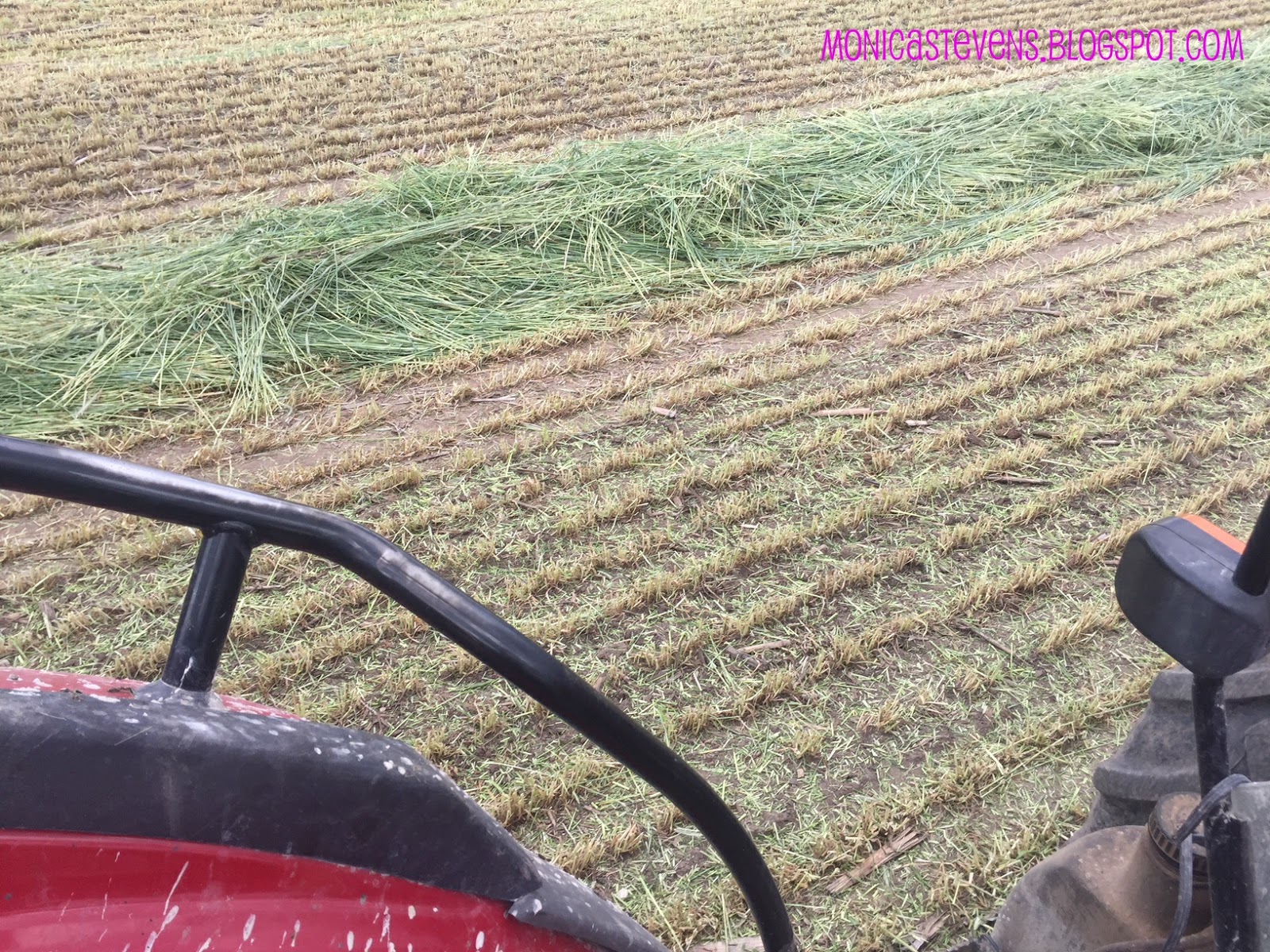
Saturday morning, I raked the cornstalks in the field dad had mowed. Shortly after I finished raking, they were custom baled for us.


Mowing the cornstalks before raking, created more volume to bale. 


Those cornstalks! A nice windrow was made after raking.


80 bales of cornstalks were rolled up on Saturday afternoon. The cornstalks will used as bedding for cows this winter and and for cows and calves this spring during the calving season. 


The cornstalks are also fed in a ration with hay, and corn silage to our cows over the winter. The cows love them.

Thursday, October 29, 2020

corn silage 2020

On October 6, corn was chopped for silage. The silage will be fed to our cows over the winter months.

A sample of silage was collected and sent to Dairyland Laboratories for analysis. The test will provide nutritional value of the feed. It is important to know the quality of the corn silage we are feeding our cows in order to meet their nutritional requirements.  

Two 100' bags were filled with corn silage for 2020. That is 200 tons of feed. Along with the silage, hay and cornstalks will also be fed to our cows.


Our cows will enjoy the corn silage this winter!


Friday, May 1, 2020

Friday on the Farm


Two fields were prepared for seeding ground for hay. We use a mixture of alfalfa, red clover, and brome with oats. We seed at a rate of 12 pounds of alfalfa, 4 pounds of red clover, 5 pounds of brome, and 2 bushel of oats per acre. The fields were drilled on April 8 and 9. Favorable weather conditions have been perfect for growth.    

Tuesday, November 12, 2019

2019 cornstalk bales


Cornstalks have been rolled up. It was just in time... they now look like frosted mini wheats for cows.
 
Every year, we rake and bale cornstalks to use during the winter and spring months. The cornstalks are used as bedding for cows during the winter and for the cows and calves during the calving season in the spring. We are anticipating another rough winter. So this year, we rolled up over 100 bales to be prepared.
 
Cornstalks are also fed to our cows. They are fed in a ration with hay and silage. It works well for us. And, our cow enjoy it.

Friday, November 8, 2019

inline wrapping hay


Three years ago, we wrapped round bales of hay for the first time. The weather would not allow us to bale hay before forecasted rain. So, we decided to set our baler in order to bale high moisture hay. The bales were then wrapped to ensile. Wrapping the bales allowed us to bale hay despite unfavorable weather conditions.

 
Over the past three years, we have continued to wrap hay. This has given us so much flexibility in baling. And, it stores our high quality hay outside for the winter. Wrapping bales shelters the hay from weather... rain, snow, and ice. So, it preserves the quality and nutritional value of our hay. 

Sunday, November 3, 2019

2019 corn silage

 
Preparing for winter, corn was chopped and bagged this fall. The silage will be used to feed our cows throughout the winter. Along with the corn silage, the cows will also be fed hay and cornstalks.  
 
 
Two 150' bags were filled with corn silage. That is 300 tons of cow chow. Hay is in short supply this year due to a frigid winter, wet spring, and dry summer. And, we are anticipating another rough winter. We chopped and bagged double the amount of corn we normally do to ensure we have the quality and quantity of feed we need for our cows.
 
A sample of the corn silage was collected and sent off to Dairyland Laboratories for feed analysis. As cattlemen, we like to know the quality of the feed to meet the nutritional requirements of our cows.

Friday, October 26, 2018

Friday on the Farm

 
It was a busy Friday on the farm. We were able to get quite a bit of work done on a nice fall day.

We have very happy cows. Two herds of cows are now grazing cornstalks. After corn is harvested, we open up fields for cows to graze. Grazing cornstalks ( stover ) in fields extends the grazing season through fall. The cows eat the corn residue ( husks and leaves ) and grass in the waterways.
 
[ view agriculture photos @ monicastevens.photoshelter.com ]

Tuesday, October 23, 2018

forage peas: week 3


I checked on the field of peas today. Oh my goodness. I love this snap of the forage peas. It is a favorite.

Friday, October 12, 2018

Friday on the Farm


So, I am checking on the field of rye this morning. It is snowing. The flakes of snow were falling from the sky and melting on the rye.  

[ agriculture photos @ monicastevens.photoshelter.com ]

Tuesday, October 9, 2018

forage peas: week 1

We drilled peas on October 2 [ post from seeding peas ] and rye on October 3. The Austrian Winter Peas are forage peas. They will be chopped and bagged next spring as silage for our cows.

emerging peas
Today, I scouted the field. I was happy to see that the forage peas were emerging! And, I am excited to see how much they grow next week!

Wednesday, October 3, 2018

forage peas

We no-till drilled peas into a field. The Austrian Winter Peas are a forage pea. These forage peas will be chopped and bagged next spring. We will use the pea silage as feed for our cows.
 
Austrian Winter Peas
The peas were seeded at a rate of 50 pounds per acre. And, they were drilled at a depth of 2 inches. Soil conditions were ideal for seeding the peas. We purchased fifty pound bags of peas to be seeded over an eight acre field. 


The peas will be an excellent forage. The pea silage will be high in protein. From what I have read, tonnage and percentage of protein depends on the maturity of the peas when harvested. When peas are beginning to blossom, they yield 1 to 2 tons per acre and are 15 to 20% protein. When peas are developing pods, they yield 1.5 to 3.5 tons per acre and are 10 to 15% protein.

I had been wanting to grow peas as forage for our cows. After two years, we decided to plant the winter peas. I am so very excited to watch them grow!


Thursday, June 14, 2018

millet

On May 27, a second field of rye was chopped and bagged. The ryelage will be used for feeding cows.  Following the rye, we decided to plant a crop for cows to graze during the summer in addition to their pasture.
 
 
We chose to no-till drill pearl millet into the field. It seemed to be the best option for us to plant. Cows will graze the field after the millet grows to a height of at least 20 inches. The field of millet will be used as rotational grazing throughout the summer. The millet will be grazed to a height of 6 to 8 inches. Grazing to this height will allow for regrowth.

We set the drill and seeded the millet at the rate of 25 pounds per acre. It was seeded at a depth of 1 inch. The soil moisture was great for seeding. Hopefully the millet will germinate quickly.

I am very excited about using the field of millet as part of grazing! And, I am looking forward to seeing the millet grow!

Friday, May 25, 2018

rye: 2018


Rye was no-till drilled on October 18 and November 1. 

 
The two fields of rye were cut on Thursday afternoon and Friday morning... one field of6 acres, and the second field of 8 acres. These fields were cut to be chopped and bagged as ryelage. And, we will feed the ryelage to cows late this summer as needed.


Rye was raked this morning to be chopped and loaded into wagons to fill a bag. 

catching rye as it is being chopped

Loads of rye were hauled back to the farm to fill the silage bag. Bagging crops like ryelage allows us to harvest high nutritional value forage and store it for later use. It has worked very well for us.


We finished chopping and bagging one field of rye. Then unfortunately, rain arrived. We were caught in a rain delay. So, we will have to wait to finish the second field of rye.

Sunday, January 7, 2018

farm calendars

Detailed record keeping and organization is vital to our Shorthorn cattle farm...


On our farm, we keep in depth records on our cows and calves. Farm calendars help us remain organized and track important dates we need to make note. Through this, we are able to better our farm management.

I use a few calendars each for different purposes...
..  A smaller monthly calendar is just for the cow herds. It notes... when cows calve during spring and fall calving (the calendar is included in our kit during calving season), when we vaccinate the herds of cows, calves, and bulls with our health program in the summer, the date bulls are turned out with the cow herds for breeding season, when embryos are implanted in recipient cows, when calves are weaned, if a feeder calf is sick and needs treatment, and  when we vaccinate and pregnancy check cows in the winter.

..  A small wall calendar will hang in the corn crib feed room. It will track when corn is rolled as feed for calves, when we take delivery of pelleted protein, feed additives and mineral, and when antibiotics are used in feed if it is needed.  

..  A large desk calendar sits on my desk of the farm office. This calendar is the my main calendar.  In addition to tracking the cattle herds, and feed records, we note weather conditions, when we cut and bale hay, along with the amount of hay harvested, and is also my personal calendar.

I found a few cute calendars at Target. [ I absolutely love Target! ] It is always nice when calendars are super cute. So, I am ready for 2018 on the farm!

Friday, December 1, 2017

Friday on the Farm


It was a gorgeous sunset. As I was feeding cattle, I enjoyed the beauty of the sun setting behind the barn and feed shed. I stood in amazement. The sky was a watercolor with shades of purple and orange. Peaceful.
 
[ agriculture photos @ monicastevens.photoshelter.com ] 

Sunday, November 26, 2017

black walnut cake

Black Walnut trees are close to my heart. They grew in our cattle pastures. And, I grew up on a farm in Walnut Grove Township, Knox County, Illinois. Here is a recipe for a delicious Black Walnut Cake!


1/2 cup      butter
1 1/2 cups      sugar
2 cups      whole wheat flour
3 teaspoons      baking powder
3/4 cup      milk
4      eggs
1 cup      black walnuts (chopped)
1 teaspoon      vanilla

Cream together the butter and sugar. Sift in the flour and baking powder. Slowly add in the milk. Mix in the chopped black walnuts and vanilla. Beat well. Blend in the eggs to the mixture. Grease and dust a 9x13 pan with flour. Bake at 350 degrees for 25-30 minutes.
 
This black walnut cake is perfect for fall and winter!

Saturday, November 4, 2017

the farm office

the farm office is the heart of the cattle farm...
  

On our Shorthorn cattle farm, it is very important to have a nice office that is purposeful and well organized. I love to be and need to be organized. Since I often work long hours at times throughout the year in my farm office, I also want a space I love. If I have an office I adore and enjoy working in, I will be much more productive. And, I do love working in my office! I think it's pretty cute...  
 
functional  +  funky
 
black saddle chair
black painted captain chair
laptop & wireless printer
iPad
telephone
desk calendar
sea grass basket [ calendar, patterned binder, portfolios, and Vigortone manual ]
b&w print magazine holder [ natural paper file folders labeled with a black Sharpie ]
clear lamp with burlap shade
2 barn board shelves
clock
sea grass basket [ black binders and a clipboard for cattle records ]
clear + turquoise tote [ calving records ]
black tray [ additional cattle records ]
purple sticky notes
patterned notepads
mini clipboard + notepad
binder clips in an antique Atlas jar
Sharpies [ in my favorite colors...lilac, purple, turquoise, magenta, orange & lime ]

In three desk drawers...
drawer #1    paperclips, business cards, notepads, rubber stamps, and ink

drawer #2    3 hole punch, pens, scissors, washi tape, and string

drawer #3    printer paper, printer ink, file folders, and legal pads


Rustic...the style I have always loved. My favorite colors to use in decorating are black and brown. Then, I add pops of color throughout... purple, yellow, or turquoise. The wall of my office is painted black. And, I absolutely LOVE it! It coordinates well with the two barn board shelves above the desk! The black wall creates a warm and cozy space for my farm office.


A clear lamp with a burlap shade sits on my desk. It adds a warm light as I work. A desk calendar with ultra-fine Sharpies keep track of everything important on the farm. A sea grass basket and b&w print magazine holder are in close reach of working at my desk... while being organized and cute. The wall clock hangs just above the desk. It can easily be seen to help keep me on task.

Onto the backs of black buttons, I glued tacks. The tacks were then pressed into the baskets. So simple and cute! They add an adorable touch to the sea grass baskets. One of these sea grass baskets holds black binders of cattle records. This basket allows quick access to records off a barn board shelf while looking rustic chic.
 
 
I had two extra wood chairs and decided to paint them black. They were sanded for a rustic look. It is perfect for an extra seating at the side of my desk!

 
To add a little of my style to my office
. soy candle
. wax warmer [ linen scented ]
. edition of Feeds and Feeding textbook
. turquoise antique Ball jars - Grandma Stevens
. antique feed scale - Grandpa Stevens
. primitive sheep figurine
. farm photos
. rope knot [ purchased @ Bishop Hill ]
 
feeds and feeding - one of my favorites
 
rope knot from bishop hill
Hanging above my desk is this cute rope knot from Bishop Hill! I love it in my office!


My favorite farm photo is a b&w print of my dad as a little boy bottle feeding his lamb. It is so cute! I will always cherish it. The framed photo goes well with the antique scale of my grandpa Stevens.
capture life
capture life...perfect for this agriculture photographer! I found this adorable wood sign at Barn Owl Primitives! It is on a barn board shelf beside a antique turquoise Ball jar.

my favorite mug from magnolia market
 I adore this mug! It was a from my visit to Magnolia Market in Waco, TX! 

Tuesday, October 10, 2017

the feed shed

The converted corn crib has been so incredibly useful to us as a feed shed on the farm...

 
protein

We are able to store protein, vitamins, and mineral. Other feed such as cotton seed hulls, oats, linseed meal, soybean meal, and square bales of hay are also stored in the feed shed. It is great having so much storage for feed, mineral, and supplies all in one location. It is perfect!

cotton seed hulls
 
cotton seed hulls

linseed meal
I am able to formulate rations, weigh, and mix feed for calves in the feed shed. Since I work off the farm as a meat inspector, I can prepare feed ahead of use. This efficiently utilizes time.


 An antique feed scale that my Grandpa Stevens used was moved over to the 'new' feed shed. I love it! The protein pellets for the feeder calves is weighed on this antique scale. It works so well! I also have a small hanging scale to weigh feed additives or small feed rations for calves.
Vigortone products
 
In 2016, I became a Vigortone dealer. I am able to keep mineral and feeders in stock now that there is more feed storage on the farm! With a big, sliding door, it is easy to take delivery of feed and mineral. And, clients are able to pick up orders with ease.  

The feed shed is also a nice place to store feed related supplies such as...buckets, feed pans, pallets, brooms, and silage hooks.

At an auction, I bought an old slate chalkboard. So cool! It will be useful for keeping track of mineral, feed rations, and feeding instructions. In the future... I plan on adding interior and exterior lighting to the feed shed to better see at night while working. Plus, I would like to add some shelving or a work bench. My hope is to add a refrigerator to store cattle vaccinations.