Welcome!

my daily life on a cattle farm, my love of agriculture, and stories behind my photos

Showing posts with label health. Show all posts

Saturday, September 2, 2017

Vigortone

Mineral is important in the roles of health, nutrition, and reproduction. We need to meet the requirements for cattle and supplement their diets with mineral. A good mineral program should be developed for cow herds throughout the year.

 
We have been using Vigortone mineral on our farm since 2000. The mineral works well for us in meeting the requirements of our cows. So, we think very highly of the products from Vigortone. 
 
 
In April 2016, I became a farmer dealer of Vigortone. This is a pretty exciting opportunity! Now, I am able to provide quality mineral to others with livestock. As a dealer, I receive a discount on purchasing mineral and earn an additional income from mineral I sell. It works out very well!


Vigortone has a wide range of mineral to offer. I stock beef cattle mineral for the seasons and store it in our feed shed. Customers can then pick up product at my location. If a product contains CTC, it requires a VFD from a veterinarian. 

We use different mineral for our cows throughout the year. Our mineral program includes...
    3V5S    January - March 

    MC Cattle Breeder CTC-CG-IGR    April - August
    3V5S CTC-IGR    September
    3V5S    October- December
Vigortone MC Cattle  Breeder CTC-CG-IGR is a chelated mineral that we use during the breeding season. It also includes CinnaGar that is consists of garlic and cinnamon extracts. CinnaGar products have shown to improve rumen efficiency.  
 
 
Mineral feeders are also available to purchase! These feeders hold up to three bags ( 150 pounds ) of mineral. The Vigortone Dura-Bull mineral feeder protects the mineral and keeps it dry from rain or snow. Our cows are fed mineral free-choice using these feeders.

 
Cows, calves, and bulls are able to utilize the mineral feeder. The rubber top is pliable for ease of use. 

 
 I can be contacted at mjstevensfeed@gmail.com! And, I am on Twitter @ MJStevensFeed. Be sure to follow me!

Thursday, February 2, 2017

calf kit

Calving season is approaching! So, I have been organizing and preparing. To help keep me focused, I made a 2017 calving task list. I crossed off another task on the list by putting together our calf kit. Check!
 
 
The calf kit carries... a roll of paper towels, Clorox wipes, pliers, flashlight, calf halter (if needed) temporary paper tags, glue, marker, calf weight tape, calving book, calendar, pregnancy records, Super 7+ iodine, and shots included in our health program. When a calf is born, we will take this kit with us.    
   
calf kit
 
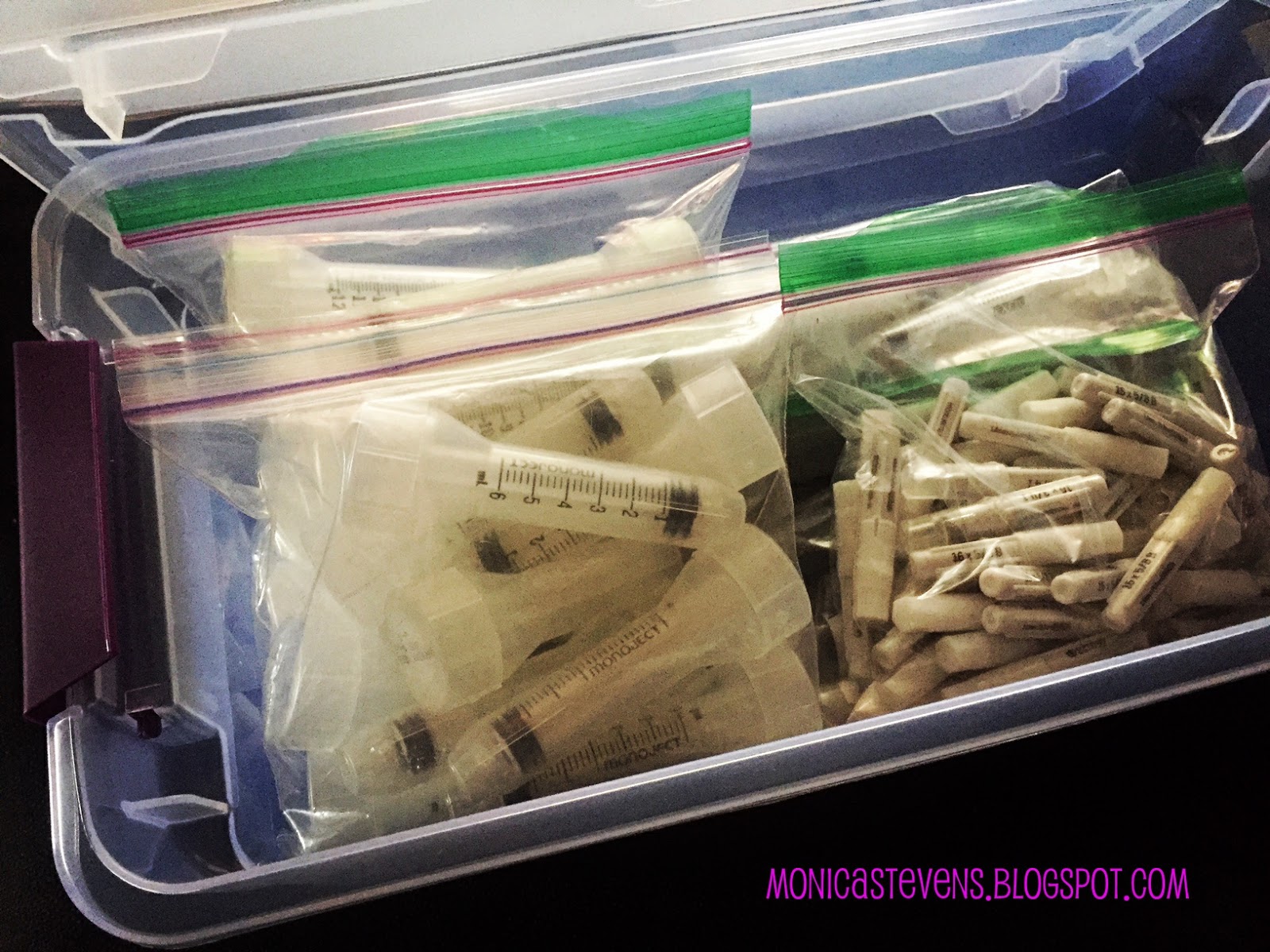
In a clear plastic box, I organized and stored extra needles and syringes of different sizes. This box is perfect to keep new needles and syringes clean and ready to use for the calving season.
 
needles & syringes
 

Friday, October 21, 2016

weaning vaccination program

weaning health program
We are weaning calves on Saturday. So, we have been very busy preparing this week...barn and lot cleaned, barn bedded with wood chips, hay in the lot, scales ready to weigh calves, corn and oats available, protein ordered, and vaccines picked up from our veterinarian. 
 
I spoke with our veterinarian earlier this week about our health program for calves at weaning. We discussed in length about our weaning health program. After chatting with Dr Baird, I ordered product to vaccinate our calves. Over the past 30 years, we have developed a great herd health program with our veterinarian. Throughout the year, we vaccinate our cows and calves to prevent disease and sickness.
 
Our calves will receive four shots when we run them through the cattle chute:
2cc BoviShield Gold
2cc 20/20 Vision 7
4cc Vitamin ADE
8cc Penicillin
 
Our weaning health program costs $7 per calf. This program will ensure us that our calves will remain healthy.    

Tuesday, June 7, 2016

The boys of summer

The boys of summer...

hello, ladies!

Four bulls were hauled to the pastures on May 28 for the breeding season. Before turning the bulls out with the cow herds for the summer, we ran them through the chute for their routine health program. Each bull received a Breeding Soundness Exam [BSE] by our veterinarian and technician, as well as vaccinations as part of our herd health program developed with our veterinarian.
 
A Breeding Soundness Exam includes: a physical examination of the bull, Scrotal Circumference [SC] measurement, and a semen sample for testing. It is crucial that each bull be able to successfully breed cows. The physical examination of the bulls includes their Body Condition Score [BCS], scrotum, eyes, legs, and feet. The bulls were evaluated for Scrotal Circumference and measured 38-45 cm. Excellent! Each bull exceeded the recommended measurement. The Scrotal Circumference measurement is important because correlates to the production of semen. A sample of semen is collected to examine underneath the microscope while on the farm. The semen sample is evaluated for sperm motility and concentration. All our bulls were classified by Dr Baird as satisfactory breeders. The bulls received a series of shots as part of our health program developed with our veterinarian... Vision 7 for pink eye, LongRange for internal and external parasites, and fly tags.  

Friday, May 15, 2015

Pelvic Area Measurements

We moved replacement heifers to pasture to graze for the season on April 15. Before doing so, we ran the heifers through the chute for tattoos, and a dose of MultiMin and LongRange.

Many factors are considered in selecting replacement heifers. This year, we decided to measure the pelvic area of our heifers. The measurements provided us with data we utilized to help select heifers. Dr Baird used the Krautman-Litton bovine pelvic in measuring the pelvic area. 


All measurements were recorded to We were very pleased with the measurements of our heifers! All heifers were suitable for calving...measuring well over 200 cm2. An larger pelvic area helps increase our chances in unassisted births.
 

Friday, June 6, 2014

Breeding Soundness Exam

paperwork from the breeding soundness exam
 
Before turning our bulls out to pasture for the breeding season, we performed a Breeding Soundness Exam [BSE]. An exam is extremely valuable for the productivity of our beef cattle herds. It was especially important to examine our herd bulls after a brutally frigid winter. We wanted to be sure that the bulls were producing viable semen for breeding. A Breeding Soundness Exam [BSE] ensures us that each bull is able to successfully breed cows. There is no better insurance than knowing bulls are able to breed. Bulls do represent 50% of the calf crop! And, a Breeding Soundness Exam cost us $50 per bull. That is money very well spent! The exam is an important tool for cattlemen to utilize.
 
Dr Baird visited our farm to examine each bull. Semen samples were collected from the bulls and evaluated under the microscope for sperm concentration and motility. Five bulls were evaluated and determined satisfactory for breeding. The bulls were also evaluated for Scrotal Circumference and measured 37-42 cm. Each bull exceeded the recommendation for their age. This measurement is taken assess the amount of semen bulls produce. Scrotal Circumference correlates to the production of semen. Bulls breed cows several times in a heat period and need to regenerate semen.


I have been very pleased with my 2013 bull that I have been raising for breeding. MJS Dirt Road Anthem 3M80 had a Scrotal Circumference of 38, and a pelvic measurement of 13x16. We were quite impressed! His measurements are excellent for a 14 month old calf!
 
A large pelvic measurement is an important genetic trait that correlates to the ease of calving. The pelvic measurement of the sire influences the pelvic measurement of his offspring. A bull with a large pelvic area should result in a larger pelvic area in his heifers.
.


Friday, February 21, 2014

Calving Records


Records are prepared for the 2014 calving season. On our farm, we raise purebred Shorthorn cattle. The records we keep and maintain are extremely important to the management of our cattle. We keep record of each calf that is born on our cattle farm. Through our records, we are able to track each calf throughout its life. When a calf is born, we note in our calving book: the date and time of birth, cow identification, coloring of and markings on the calf, birth weight, calving ease, the sire, and any other important information in regards to the calf. The daily calving book is kept with the calf vaccination kit. 


the calving book is important to our cattle herd records


At birth, each calf receives temporary identification that matches the numbered ear tag of the cow. A paper hip tag is used to match a calf with the cow until we tag the calf with a numbered ear tag.
 
a paper hip tag serves as temporary identification for a calf

A list is kept as calves are born. I maintain this list to prepare numbered ear tags for heifer calves and bull calves. The calving list notes: cow, farm, heifer or bull, sire, hip tag number, and numbered ear tag. Heifers receive a yellow numbered tag, and bulls receive an orange numbered tag. Calves born on one farm will be tagged in their left ear, and calves born on another farm will be tagged in their right ear.


records are important in a purebred cattle herd
 
In the calf vaccination kit, we also include a list from pregnancy checking cows. This list helps us determine when a cow will calve.


pregnancy checking list with due dates
 

Saturday, November 30, 2013

Pregnancy Checking and Vaccinations: Fall 2013

preparing to vaccinate and pregnancy check heifers and cows
 
It was a gorgeous, sunny day! Today we pregnancy checked a herd of 57 cows and heifers that will be calving next spring. As Dr Baird pregnancy checked each cow or heifer, I recorded the information for our records. Our cow herds are due to calve in March and April. With Dr Baird, we also vaccinated our cattle herd with our pre-calving health program. We will be pregnancy checking and vaccinating the second herd of cows another day.

Friday, November 29, 2013

2013 Replacement Heifers

one of my 2013 replacement heifers

 
This afternoon, we vaccinated our calves. We have created a health program for our cows and calves with guidance from our veterinarian, Dr Baird. For this year, we selected twelve heifers to add to our cow herd. Our replacement heifers were calfhood vaccinated and tagged with a new, red numbered ear tag for identification. The heifers will be turned out to pasture in April. And at the end of May, a bull will be turned in with the heifers for the breeding season. 

Friday, April 19, 2013

A Cattleman

a shorthorn cow is licking her newborn heifer calf

A healthy, vigorous calf is what being a cattleman is all about. My family is extremely dedicated to caring for our Shorthorn cattle herds. Since 1943, the care for our cattle has been a tradition. As a third generation cattleman, I am proud of my family's tradition. The care for our cow herds' health and nutrition is shown in our healthy calves. We have been truly blessed this calving season with amazing calves. 

Monday, January 28, 2013

Fall 2012

Due to the extremely hot and dry weather conditions this past summer, we weaned calves a month early. Normally in the middle of September, we decided to wean calves in the middle of August. We chose to wean calves early to save pastures for grazing, maintain body condition, and maintain pregnancies. Despite the heat and lack of forage, I was pleasantly surprised with weaning weights. On average, steers and heifers weighed 40-60 pounds less than previous years. I was relieved and fairly pleased, considering. Since weaning, calves have been healthy and growing very quickly. I am very happy with the quality of calves this year.
 
With the warm, fall weather, we built fence. It is one of my favorite jobs on the farm! We use hedge posts, steel posts, four strands of barbed wire, and electrify one strand of high tensile for pasture fence. More fence is yet to be built. We showed calves to a family looking for a steer to show this summer. And, I was very pleased with the steer calf they chose. I wish them the best of luck! I decided to keep two bull calves to raise as breeding bulls to sell. I have never raised bulls, so it has been a good learning experience. Halter breaking the bulls to lead was very easy. We selected 12 replacement heifers to retain in the herd. I am extremely happy with the quality of heifers. Our veterinarian calfhood vaccinated our replacement heifers. The feeder calves were also revaccinated as part of their health program. We pregnancy checked and vaccinated cows with a pre-calving health program we developed with our veterinarian. I was so nervous about pregnancy checking our cows this fall in fear of low conception rates and the 2013 calving season being stretched out much longer due to the breeding conditions this past summer. If that was the issue, it would take a few years to get cows back on schedule. Ugh. I hoped for the best and was very pleased with herd averages of 98% conception. I am looking forward to calving season!

Monday, December 26, 2011

Another Successful Year

Calves have been weaned and vaccinated with their first round of shots since September 17th. With warm and dry weather we had after weaning, there was no need to run any calves through the chute to treat for coughs, temperatures or runny noses. Weaning weights this fall were average for both steers and heifers at each herd. This was expected with the hot, dry summer we had. It is amazing how quickly the calves are growing. Looks like I will be halter breaking heifers very soon!

Since the crops were harvested, the cows grazed on corn stalks in the fall. What a pretty sight, especially with a gorgeous fall sunset in the background! November 26th and 27th, we pregnancy checked and vaccinated our cattle herds with our pre-calving health program. We were very pleased that our cattle had a conception rate of 98.5% and were due to calves in March and April. Our calves received their second round of vaccinations on December 17th. My dad and I went through the selection process of choosing replacement heifers. Each year we retain 12-14 head of heifers or about 20% of our herd. This year, we chose 12 head of heifers. They received their calfhood vaccination from our vet, Dr Baird. We put in a new numbered tag to identify our heifers. I recorded data to prepare for registering our heifers for pedigrees with the American Shorthorn Association.